What Is the SCL Waiver? A Clear Guide for IDD Providers — and How Care2U Supports Your Community
What Is SCL and Why It Matters More Than You Think
If you support individuals with intellectual and developmental disabilities (IDD), you’re already balancing a lot: staffing, compliance, communication, and day-to-day care.
And then there’s SCL.
You hear it in meetings. It shows up in care plans. It drives referrals and funding. But it’s often not explained clearly.
Understanding how SCL works and how it connects to IDD is extraordinarily helpful because it directly impacts how smoothly your operations run and how well your residents are supported.
Let’s break it down in plain terms.
What Is IDD?

Before talking about SCL, it’s important to clarify IDD.
IDD (Intellectual and Developmental Disabilities) is a clinical term used to describe individuals who have limitations in intellectual functioning and adaptive behavior, typically beginning before age 22.
This includes conditions such as:
Autism spectrum disorder
Down syndrome
Cerebral palsy (in many cases)
Traumatic brain injury with developmental impact
IDD describes the person, not the system around them.
And that distinction matters.
Using the right language builds trust with families, support coordinators, and your own staff. It also ensures communication stays clear and respectful across care teams.
What Is SCL?
SCL (Supports for Community Living) is not a diagnosis.
It’s a Medicaid waiver program that funds services for individuals with IDD so they can live in community settings instead of institutions.
In simple terms:
IDD = what the person is living with
SCL = how their care is funded
The SCL waiver typically covers services like:
Personal care (bathing, dressing, mobility)
Supported living and residential services
Day programs and community access
Behavioral support
Respite care for families
Assistive technology and home modifications
For providers and administrators, SCL is the framework that determines:
What services can be delivered
How they are documented
How they are reimbursed
What compliance standards must be met
And that’s where complexity and stress often shows up.
Where Things Break Down Operationally
On paper, the system makes sense.
In practice, it can feel fragmented.
You may recognize some of these challenges:
Disconnected care teams
Pharmacy, primary care, and behavioral health often operate separately, leading to gaps in communication.Delays in medication or authorizations
A missing prescription detail or prior authorization can slow everything down.Compliance pressure
Documentation requirements are strict, and small issues can turn into citations.Transportation burden
Getting individuals with IDD to off-site appointments takes time, staff, and coordination.Communication bottlenecks
Waiting on callbacks, emails, or portals can delay care decisions.
These aren’t people problems. They’re system problems.
And they’re exactly where the right care model makes a difference.
What Better Looks Like: A More Coordinated Approach
When SCL-supported care works well, it feels different.
Medications arrive on time, without follow-up calls
Providers communicate directly, without layers
Appointments happen on-site when possible
Documentation supports compliance instead of creating stress
Your team spends less time coordinating and more time caring
This is what a coordinated care model is designed to deliver.
And it’s the foundation of how Care2U operates.
How Care2U Supports Individuals with IDD (Through SCL)

Care2U was built around a simple idea:
Care works better when it’s connected.
Instead of separating pharmacy, primary care, and behavioral health, Care2U brings them together into one coordinated, local team.
1. One Team, Not Three
Care2U integrates:
Pharmacy services
Mobile primary care
Behavioral health support
This means fewer handoffs, fewer gaps, and clearer communication across the entire care plan.
Instead of chasing updates between providers, your team works with one connected system.
2. On-Site Care That Reduces Disruption
Transportation is one of the biggest operational burdens in IDD care.
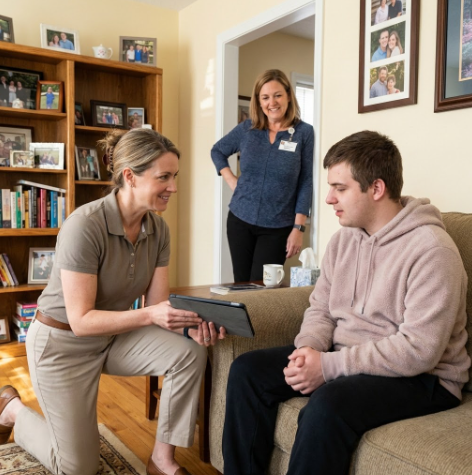
Care2U addresses this by bringing providers directly to the home or facility.
Routine visits happen on-site
Follow-ups happen faster
Staff coordination is simplified
As one partner shared, this approach eliminates the constant challenge of off-site appointments, making care more consistent and less disruptive.
3. Direct, Real-Time Communication
When something goes wrong, waiting isn’t an option.
Care2U provides direct access to real people often through text or secure messaging so issues can be resolved quickly.
Clear, quick communication when you need it.
This responsiveness is consistently highlighted by partners as a key differentiator, especially compared to larger, less accessible providers.
4. Faster Medication Delivery and Coordination
Medication delays don’t just create inconvenience. They create risk.
Care2U’s integrated pharmacy model ensures timely delivery, coordinated prescription management, and fewer gaps between orders and administration.
Because pharmacy and clinical teams are aligned, issues can be addressed before they escalate.
5. Proactive Compliance Support
SCL environments come with strict regulatory expectations.
Care2U is designed to support that reality by flagging potential prescription issues early, supporting documentation needs, and helping reduce audit risk through proactive coordination.
This is an area where many providers feel pressure and where having a knowledgeable, engaged partner matters.
Why This Matters for Your Team
At the end of the day, SCL isn’t just a funding mechanism.
It shapes how care is delivered every day.
When systems are fragmented:
Your staff carries the burden
Small issues become bigger problems
Time is spent coordinating instead of caring
When care is coordinated:
Your team has clarity
Communication is faster
Residents receive more consistent support
Care2U is built to reduce that operational weight, not add to it.
For Care2U, the goal is simple: to bring pharmacy and medical care together into one local, accountable system that improves outcomes and reduces complexity.
Bringing It All Together
Here’s the simplest way to think about it:
IDD describes what the individual lives with
SCL funds the support the individual receives
Care2U connects the care around such individuals
When those three pieces align, care becomes more predictable, more responsive, and easier to manage.
A Final Word
If you’re navigating SCL every day, you don’t need more complexity.
You need a partner who understands how your world actually works and helps make it smoother.
Care2U is designed to be that partner.
Steady when things get busy.
Responsive when something goes wrong.
And coordinated so nothing falls through the cracks.
If you’re exploring ways to simplify care for individuals with IDD, it’s worth starting a conversation with us by scheduling a free meet-and-greet.